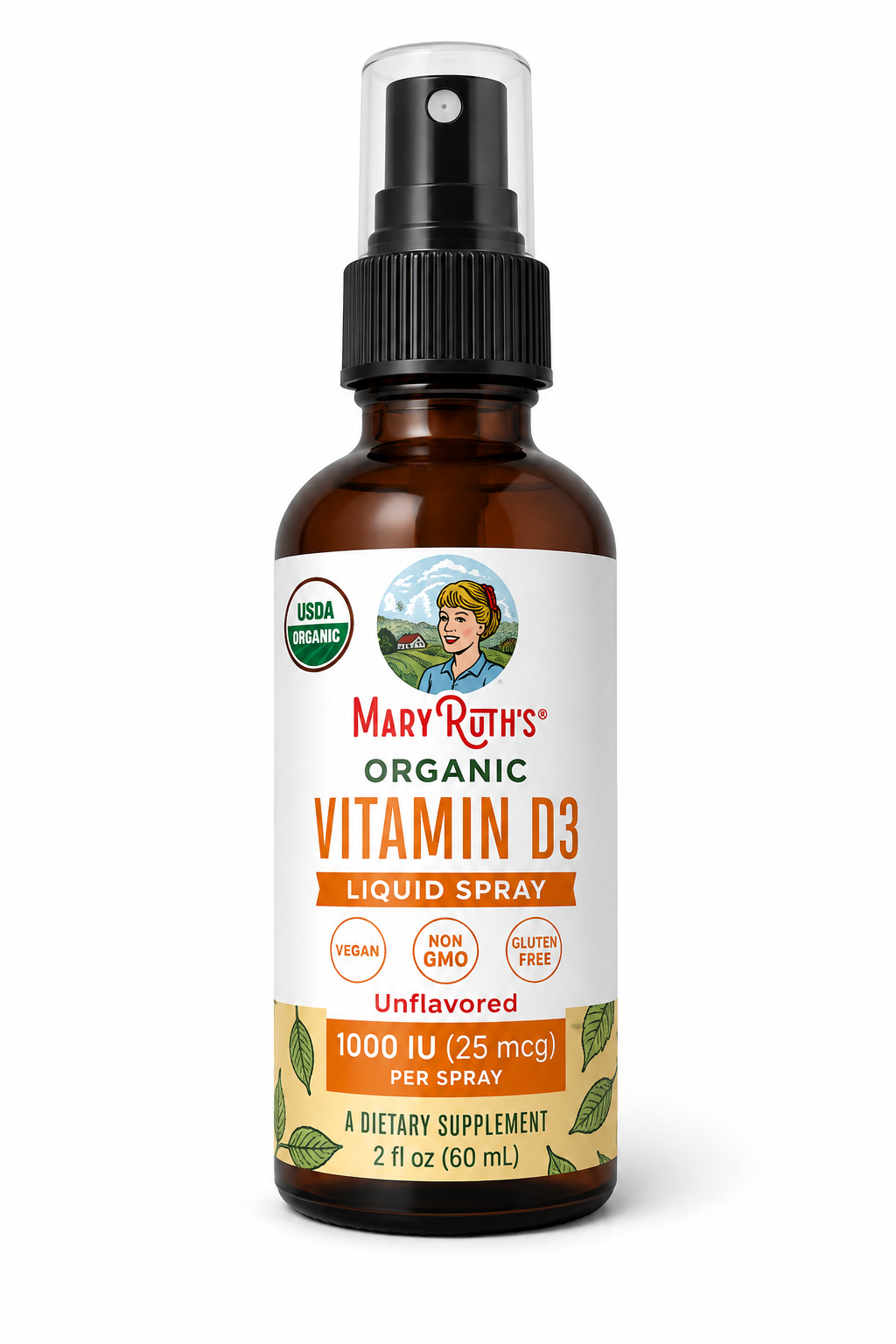
Vitamin D in One Minute
The Essential Facts
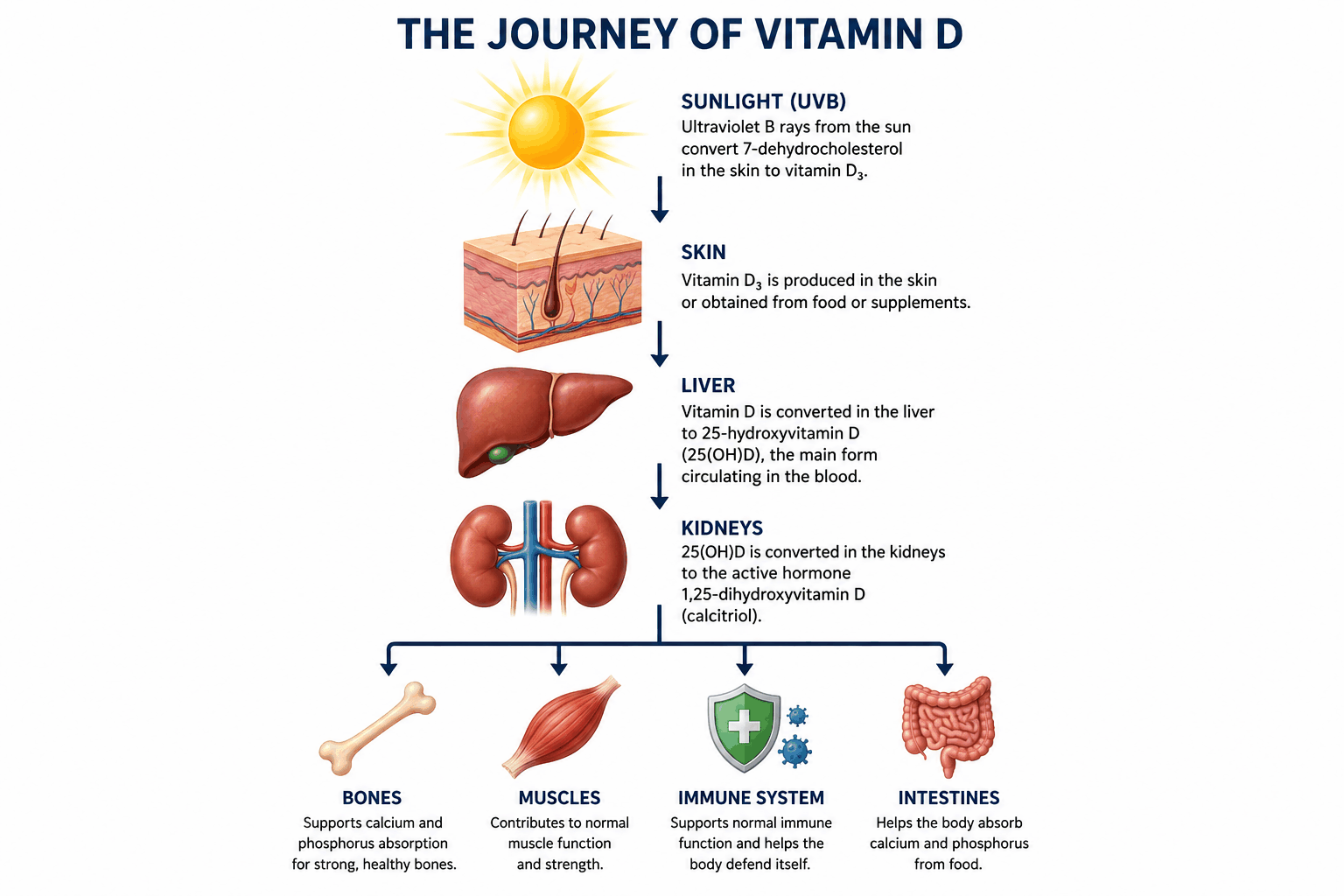
Vitamin D is often called the sunshine vitamin, but it is much more than that. Unlike most vitamins, vitamin D behaves like a hormone. It is produced in the skin after exposure to ultraviolet B (UVB) sunlight, then undergoes activation in the liver and kidneys before it can carry out its functions throughout the body. Its most well-established role is helping the body absorb calcium and phosphorus, two minerals that are essential for maintaining healthy bones and teeth. Without enough vitamin D, even a diet rich in calcium cannot be used efficiently.
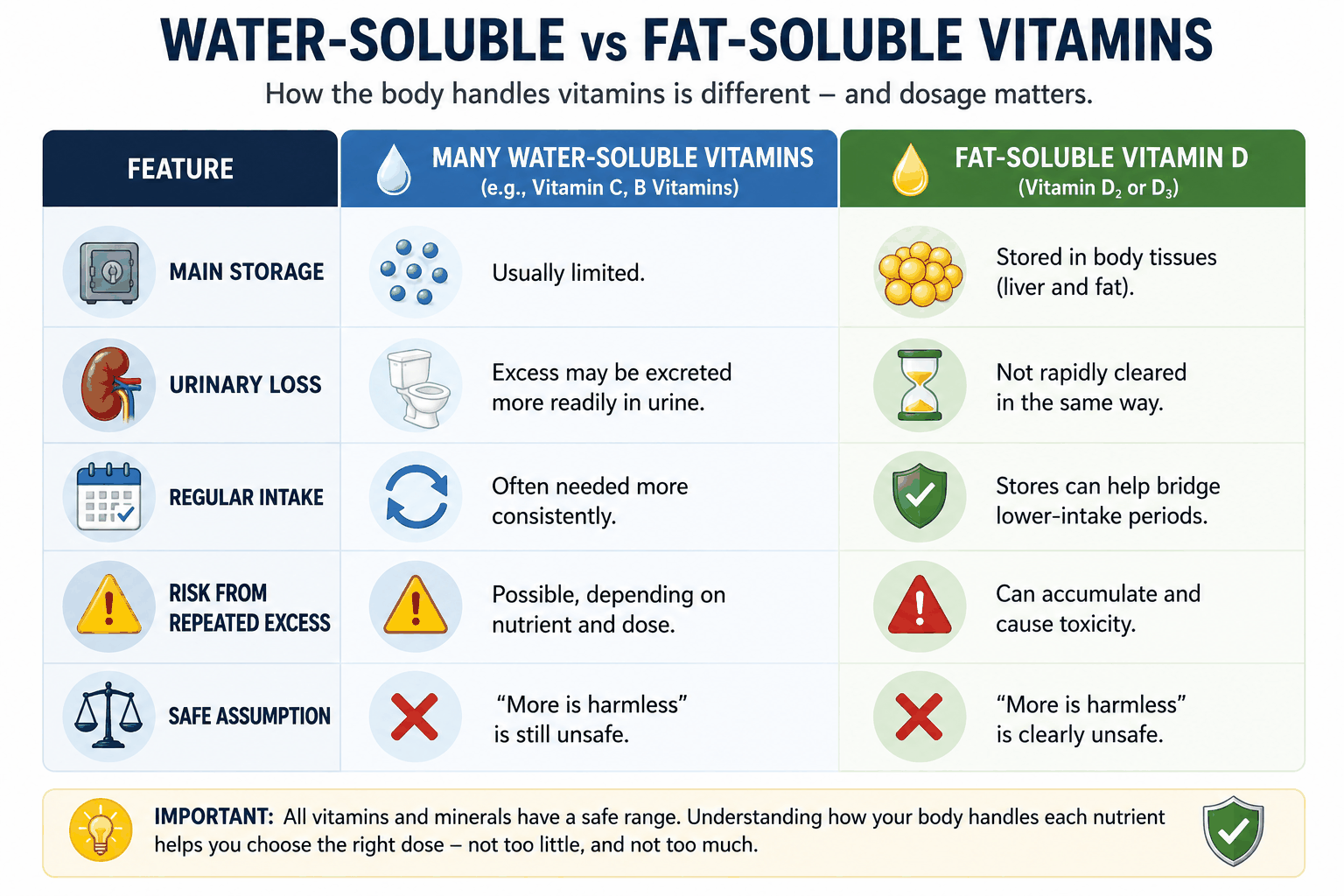
Vitamin D also contributes to normal muscle function and supports several aspects of immune function. These roles are well supported by scientific evidence. However, claims that vitamin D prevents or treats a wide range of unrelated diseases are often stronger than the current evidence allows. Research is ongoing, and some questions remain unanswered. One of the most important facts about vitamin D is that it is fat-soluble. Unlike many water-soluble vitamins, vitamin D can be stored in body fat and the liver. This allows the body to draw on reserves over time, but it also means that repeated high doses can accumulate. For this reason, vitamin D should be taken thoughtfully rather than casually.
Deficiency is common in some populations, especially where sunlight exposure is limited or certain medical conditions affect absorption. At the same time, more is not always better. Taking excessive amounts over weeks or months can lead to vitamin D toxicity, usually by causing calcium levels in the blood to become dangerously high. The goal is not to fear vitamin D. The goal is to understand it. When used appropriately, vitamin D is one of the most important nutrients for maintaining normal health. When misunderstood or taken inappropriately, it can also become one of the easiest supplements to misuse.
TAFAT Quick Facts
Question Quick Answer
What is vitamin D?
A fat-soluble vitamin that also functions like a hormone.
What is its main job?
Helping the body absorb calcium and phosphorus for healthy bones and muscles.
Where does it come from?
Sunlight, certain foods, and supplements.
Can the body store it?
Yes. Vitamin D can remain stored in body fat and the liver.
Can you take too much?
Yes. Excessive supplementation over time can lead to vitamin D toxicity.
Should everyone take high doses?
No. Supplement needs depend on individual circumstances and medical advice.
Truth Meter™
Statement Evidence
Vitamin D is essential for healthy bones.
🟢 Well Supported
Vitamin D is stored in the body.
🟢 Well Supported
Everyone should take large doses every day.
🔴 Not Supported
More vitamin D always produces better health.
🔴 Not Supported
Some people genuinely need supplementation.
🟢 Well Supported
Vitamin D is not remarkable because it should be taken in large amounts. It is remarkable because the right amount, for the right person, at the right time, supports health in ways that few nutrients can.
What Is Vitamin D?
More Than an Ordinary Vitamin
Vitamin D is often called a vitamin, but in the body it behaves in several ways like a hormone precursor. Most vitamins must be obtained mainly from food. Vitamin D is unusual because the body can produce vitamin D₃ in the skin when ultraviolet B sunlight reaches a cholesterol-related compound called 7-dehydrocholesterol. Vitamin D obtained from sunlight, food, or supplements is not yet fully active. It must first pass through a sequence of conversions, principally in the liver and kidneys. This makes vitamin D less like a simple nutrient placed directly into the body and more like a message that must be prepared before it can be read.
The Vitamin D Family
“Vitamin D” is an umbrella term rather than one single substance.
The two forms most often seen in food and supplements are:
Vitamin D₂
Ergocalciferol
Vitamin D₂ is generally produced from fungi or yeast exposed to ultraviolet light.
Vitamin D₃
Cholecalciferol
Vitamin D₃ is the form produced in human skin after suitable UVB exposure. It is also found in some animal-derived foods and is commonly used in supplements. Both forms can raise vitamin D status, although they are not always identical in how strongly or how long they affect blood concentrations. We will compare them more closely later in this guide.
How Vitamin D Becomes Active
Whether vitamin D comes from sunlight, food, or a capsule, it must be processed.
Step 1: Skin or intake
Vitamin D₃ may be produced in the skin, while vitamin D₂ or D₃ may also enter through food or supplements.
Step 2: The liver
The liver converts vitamin D into 25-hydroxyvitamin D, commonly written as: 25(OH)D This is the principal circulating form and the form most often measured in a vitamin D blood test.
Step 3: The kidneys
The kidneys convert part of that circulating vitamin D into 1,25-dihydroxyvitamin D, also known as calcitriol. Calcitriol is the hormonal active form. It helps regulate calcium and phosphorus balance by acting on the intestines, kidneys, bones, and other tissues.
Why Call It a Hormone?
A hormone is a chemical messenger produced or activated in one part of the body that influences tissues elsewhere.
Active vitamin D fits that description because it:
binds to vitamin D receptors in cells;
influences the activity of certain genes;
helps regulate calcium and phosphorus;
communicates with the intestines, kidneys, bones, and parathyroid glands.
For ordinary readers, the clearest wording is:
Vitamin D is classified as a vitamin, but its active form functions in the body like a hormone.
This is more accurate than simply saying vitamin D “is a hormone,” because the term vitamin D includes several inactive and intermediate compounds.
Its Best-Established Role
Vitamin D’s clearest and most firmly established function is helping maintain normal calcium and phosphorus concentrations. It increases the intestine’s ability to absorb these minerals, making normal bone mineralisation possible. When vitamin D is severely deficient, children may develop rickets and adults may develop osteomalacia, in which bones become poorly mineralised and weakened. Vitamin D also contributes to normal muscle and immune function, but this does not mean that taking extra vitamin D automatically improves every condition involving muscles or immunity. Biological involvement is not the same as proof that supplementation prevents or treats disease.
Vitamin D Is Fat-Soluble
Vitamin D belongs to the group of fat-soluble vitamins, together with vitamins A, E, and K.
This means:
it is absorbed more effectively in the presence of dietary fat;
it can be stored in body tissues;
repeated doses may accumulate;
excess intake is not necessarily cleared rapidly in urine.
Vitamin D’s ability to remain in the body is useful because it provides reserves during periods of lower intake or sunlight. Yet that same feature means chronic excessive supplementation can become harmful.
Vitamin, Hormone, or Both?
Description Is it accurate?
Vitamin D is a nutrient
Yes
The skin can produce vitamin D₃
Yes
Vitamin D must be activated
Yes
Active vitamin D behaves like a hormone
Yes
Every vitamin D compound is already active
No
More vitamin D always creates more benefit
No
TAFAT Research Highlight
🟢 Well Supported
Vitamin D is a fat-soluble nutrient whose active metabolite regulates calcium and phosphorus metabolism through hormone-like signaling. Its pathway through the skin, liver, and kidneys is well established in human physiology.
Vitamin D is not merely swallowed and used immediately. It must be produced or absorbed, transported, converted, regulated, and finally activated.
How the Body Makes and Activates Vitamin D
A Journey Through Skin, Liver, and Kidneys
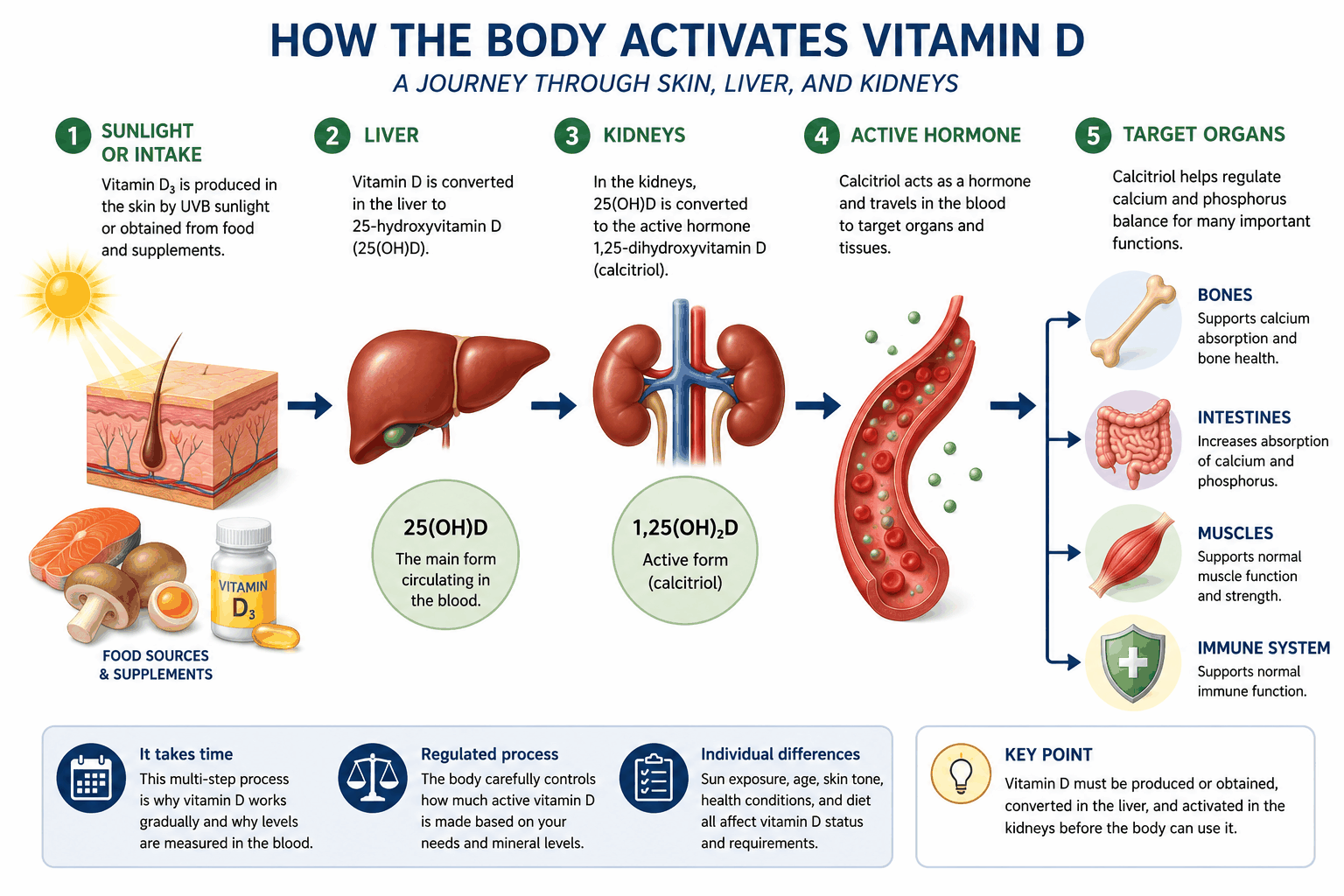
Vitamin D does not arrive in the body fully active. Whether it begins with sunlight, food, or a supplement, it must travel through a carefully regulated pathway before the body can use it effectively. That pathway usually involves three main stages:
Production or intake
Conversion in the liver
Activation in the kidneys
The body creates vitamin D from direct sunlight on the skin, but the amount produced varies widely according to season, latitude, skin pigmentation, clothing, age, cloud cover, and time spent outdoors.
Step 1: Sunlight Reaches the Skin
Ultraviolet B radiation from sunlight reaches the skin and acts on a cholesterol-related compound called 7-dehydrocholesterol. This begins the formation of vitamin D₃, also called cholecalciferol. Vitamin D can also enter the body through:
food;
fortified products;
vitamin D₂ supplements;
vitamin D₃ supplements.
Whether it comes from the skin or from something swallowed, it is still not fully active at this stage.
Step 2: The Liver Creates the Main Circulating Form
Vitamin D travels to the liver. There it is converted into:
25-hydroxyvitamin D
This is usually written as:
25(OH)D
It is the main form circulating in the bloodstream and the form most commonly measured when a healthcare professional orders a vitamin D blood test. This form acts as a useful marker of vitamin D status because it reflects vitamin D obtained from both sunlight and intake.
Step 3: The Kidneys Produce the Active Hormone
The kidneys convert part of the circulating 25(OH)D into:
1,25-dihydroxyvitamin D
This is also called:
Calcitriol
Calcitriol is the hormonal active form of vitamin D. It acts on the intestines, bones, kidneys, and other tissues to help regulate calcium and phosphorus. The kidneys are therefore not merely filters in this story. They are part of the activation pathway. This is one reason kidney health can affect vitamin D metabolism.
The Pathway at a Glance
Stage -Location -What Happens
1
Skin or digestive tract
Vitamin D₃ is produced, or vitamin D₂/D₃ is absorbed
2
Liver
Vitamin D is converted to 25(OH)D
3
Kidneys
25(OH)D is converted to active calcitriol
4
Target tissues
Active vitamin D helps regulate calcium, phosphorus, bones, muscles, and related functions
Why the Process Is Regulated
The body does not simply activate every molecule of vitamin D at once. The pathway is influenced by:
calcium levels;
phosphorus levels;
parathyroid hormone;
kidney function;
the amount of vitamin D already available;
other regulatory signals.
This regulation helps maintain mineral balance. It also explains why taking more vitamin D does not necessarily mean the body will gain more benefit.
Sunlight Is Not a Fixed Dose
It is tempting to think that a certain number of minutes in sunlight will always produce the same amount of vitamin D. That is not true. Production varies according to:
season;
geographic latitude;
time of day;
skin pigmentation;
age;
clothing;
cloud cover;
glass barriers;
amount of skin exposed;
sunscreen use in real-world conditions.
Darker skin contains more melanin, which reduces UVB penetration and may lengthen the time needed to produce the same amount of vitamin D. People of every skin tone should still avoid sunburn and follow appropriate sun-safety guidance.
Sunlight can help the body make vitamin D, but it is not a precise or universally predictable dose.
A Note About Sun Safety
Vitamin D is important, but deliberate burning or excessive ultraviolet exposure is not a safe strategy. The same UV radiation involved in vitamin D production can also damage skin. A balanced guide should therefore avoid telling readers to abandon sunscreen, use tanning beds, or remain in strong sunlight until the skin reddens. Food and supplements can provide vitamin D without requiring unsafe sun exposure.
TAFAT Research Highlight
🟢 Well Supported
The vitamin D pathway through the skin, liver, and kidneys is well established. The liver produces the main circulating form, 25(OH)D, while the kidneys help produce calcitriol, the active hormonal form.
Vitamin D is not simply taken and used. It must be produced or absorbed, carried, converted, regulated, and activated.
That journey is why dose, organ function, sunlight exposure, and medical circumstances all matter.
Why Vitamin D Matters
A Small Nutrient With a Remarkably Important Role
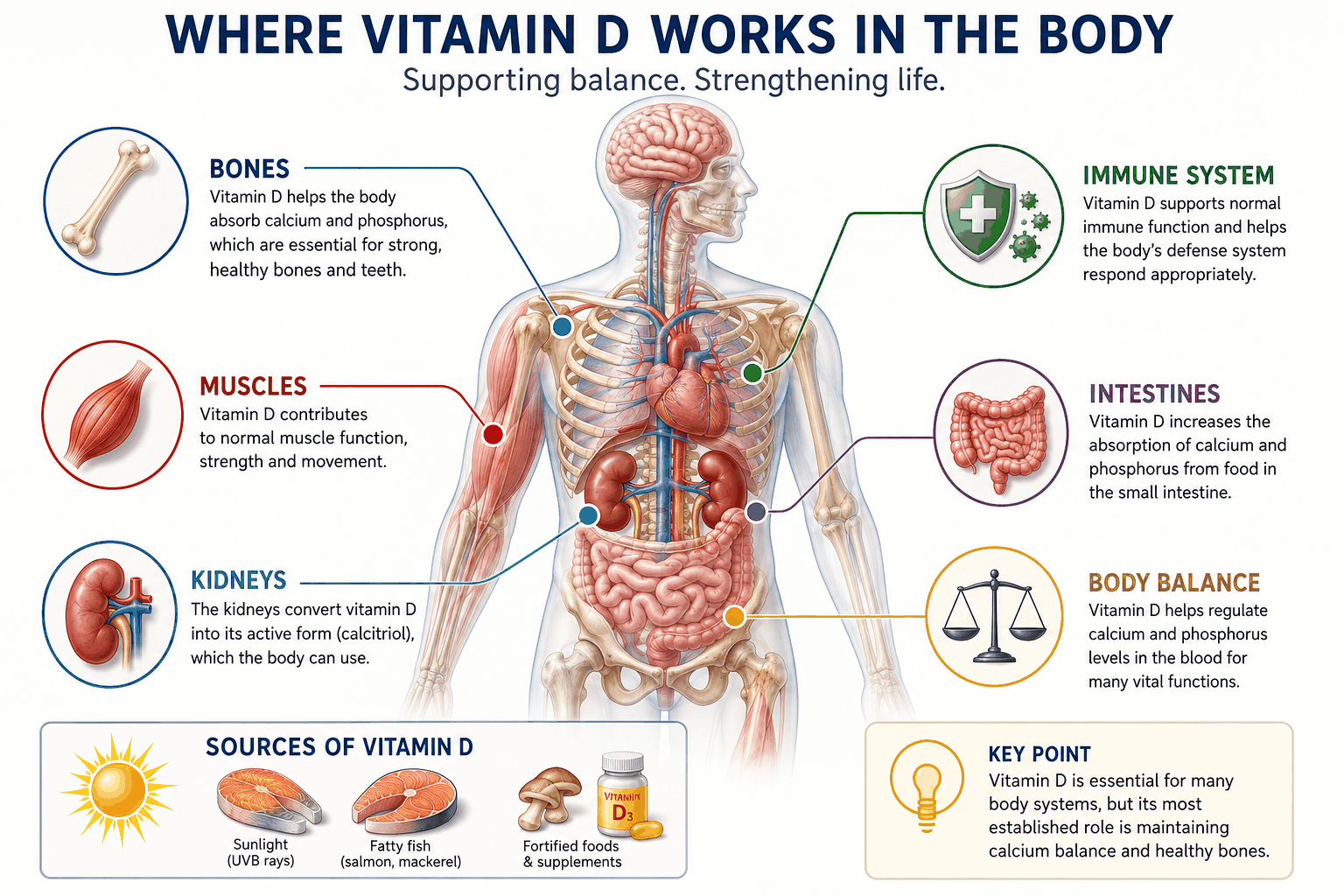
When people hear the words vitamin D, they often think only about bones. Healthy bones are certainly one of vitamin D’s most important functions, but its influence extends much further. Every day, millions of cells rely on vitamin D to help maintain the body’s delicate balance of calcium and phosphorus. Without enough vitamin D, this balance begins to falter. Rather than working in isolation, vitamin D acts like a quiet coordinator, helping different organs communicate and perform their roles effectively.
Building Strong Bones
Perhaps vitamin D’s best-known responsibility is helping the small intestine absorb calcium and phosphorus from food. Without adequate vitamin D, much of the calcium consumed in the diet simply cannot be absorbed efficiently. Even a calcium-rich diet becomes less effective if vitamin D levels are too low. Over time, inadequate vitamin D may contribute to poor bone mineralisation. In children, severe deficiency can lead to rickets, where growing bones become soft and may develop deformities. In adults, prolonged deficiency can contribute to osteomalacia, causing bone pain, tenderness, muscle weakness, and an increased risk of fractures. Older adults may also face a higher risk of falls and fractures when vitamin D deficiency contributes to muscle weakness.
Supporting Healthy Muscles
Bones provide structure, but muscles allow us to move. Vitamin D contributes to normal muscle function by helping muscle cells work efficiently. Deficiency has been associated with muscle weakness and reduced physical performance, particularly in older adults. This does not mean that taking high-dose vitamin D will automatically improve athletic performance or build muscle. If vitamin D status is already adequate, additional supplementation has not consistently shown extra benefit for muscle strength in healthy people. Research continues in this area.
TAFAT Insight
Correcting a deficiency is very different from trying to improve something that is already functioning normally.
Helping the Immune System
The immune system is one of the most talked-about areas of vitamin D research. Vitamin D contributes to the normal functioning of the immune system, and vitamin D receptors are found on many immune cells. This tells us that vitamin D plays a role in immune regulation. However, this does not mean vitamin D is a cure for infections or that taking more than needed provides greater protection. Some studies have found modest benefits in specific populations with low vitamin D status, while others have shown little or no effect. The strongest evidence supports maintaining adequate vitamin D levels rather than taking excessive doses in the hope of preventing illness.
Keeping Calcium in Balance
Vitamin D works closely with:
Calcium
Phosphorus
The kidneys
The intestines
The parathyroid glands
These systems continually communicate to keep blood calcium within a narrow and healthy range. If calcium falls too low, the body responds by adjusting hormone levels, increasing vitamin D activation, and, if necessary, drawing calcium from bone stores. This finely balanced system highlights an important truth:
Vitamin D is not simply about bones. It is about maintaining balance throughout the body.
More Than One Job
Scientists continue to investigate vitamin D’s relationship with many areas of health, including:
cardiovascular health;
diabetes;
autoimmune diseases;
mood disorders;
cognitive health;
certain cancers.
These areas are the subject of active research, but the evidence is often mixed or inconclusive. While vitamin D is essential for normal physiology, supplementation has not consistently been shown to prevent or treat many of these conditions in the general population. For this reason, TAFAT distinguishes between well-established biological roles and emerging research.
Established vs Emerging Evidence
Topic Current Evidence
Bone health
🟢 Strong
Calcium absorption
🟢 Strong
Prevention of rickets
🟢 Strong
Prevention of osteomalacia
🟢 Strong
Normal muscle function
🟢 Strong
Normal immune function
🟢 Strong
Cancer prevention
🟠 Mixed evidence
Heart disease prevention
🟠 Mixed evidence
Depression treatment
🟠 Mixed evidence
Universal infection prevention
🔴 Not established
Why Deficiency Matters
Vitamin D deficiency does not usually develop overnight. It often develops gradually as the body’s stores decline over weeks or months. Because the symptoms can be subtle, many people do not recognize the problem immediately. Possible signs of deficiency may include:
tiredness;
muscle weakness;
bone discomfort;
increased risk of fractures in susceptible individuals.
These symptoms are not specific to vitamin D deficiency and can have many other causes. A blood test measuring 25-hydroxyvitamin D [25(OH)D] is the standard way to assess vitamin D status.
TAFAT Research Highlight
🟢 Well Supported
Vitamin D is essential for maintaining normal calcium and phosphorus balance, supporting healthy bones, and contributing to normal muscle and immune function. Many additional claims continue to be studied, but not all have been confirmed by high-quality clinical evidence.
Vitamin D is important because it helps the body maintain balance, not because it promises extraordinary results.
Its greatest strength lies in quietly supporting normal human physiology, one carefully regulated process at a time.
Fat-Soluble Does Not Mean Harmless
Why Vitamin D Can Accumulate
Many people were taught a simple rule:
“Your body uses what it needs and urinates out the rest.”
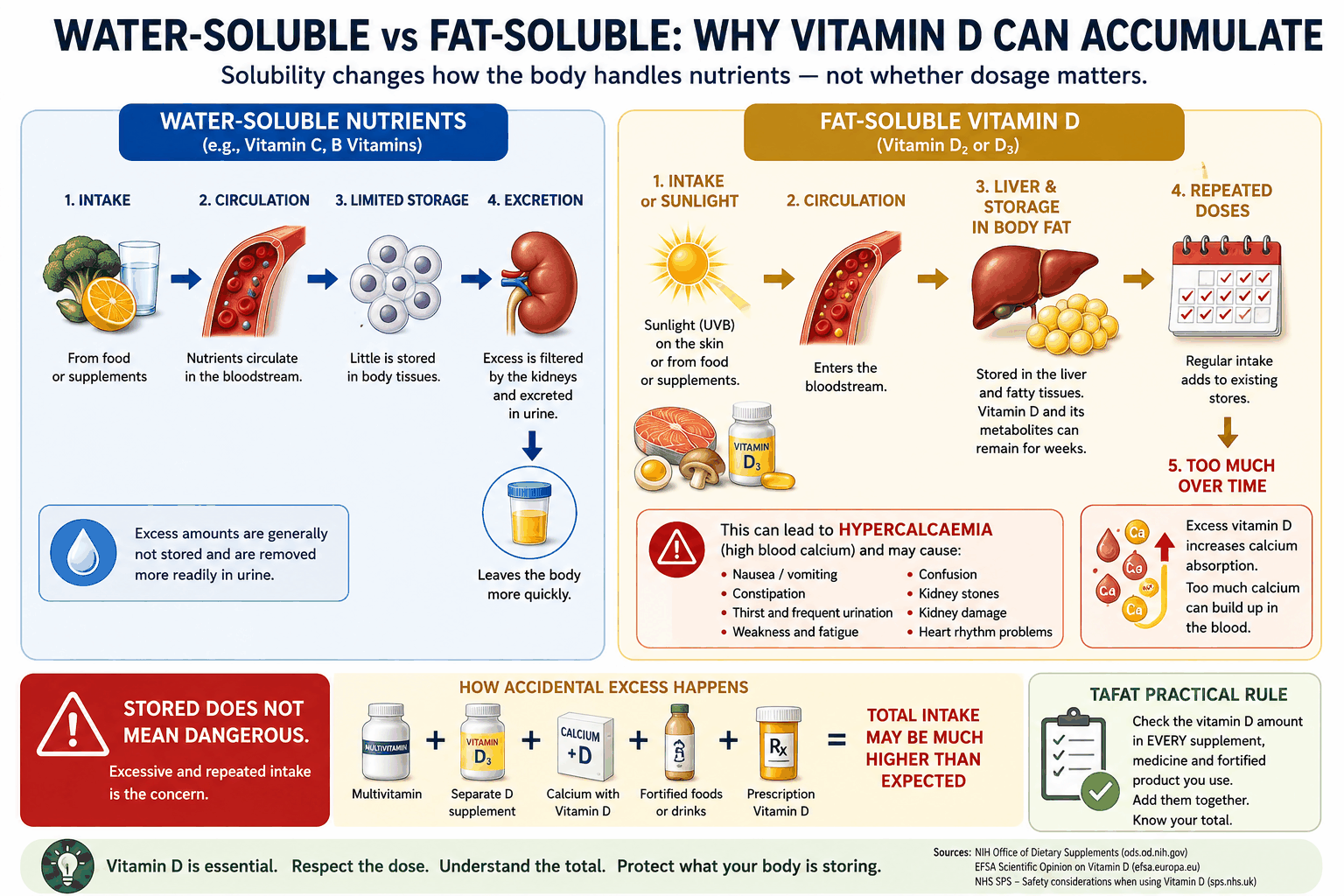
That idea is partly true for some water-soluble vitamins, but it is not a safe rule for every nutrient. Vitamin D is fat-soluble. This means the body can store it in fatty tissue and the liver rather than clearing each dose quickly through urine. That storage is useful because it helps maintain vitamin D availability when sunlight or dietary intake is low. The same ability to store vitamin D, however, means repeated excessive doses can gradually accumulate. The problem is usually not one ordinary supplement dose.
It is more often:
taking high doses repeatedly;
combining several products containing vitamin D;
continuing a prescribed loading dose longer than directed;
misunderstanding micrograms and international units;
or using supplements without considering kidney, calcium, or medical conditions.
Stored Does Not Mean Permanently Trapped
It is important not to describe vitamin D as though one capsule remains unchanged inside the body for exactly a month. Vitamin D is absorbed, stored, converted, used, and gradually broken down. Its circulating metabolites remain in the body much longer than many water-soluble nutrients, but the duration varies according to:
dose;
body fat;
sunlight exposure;
liver and kidney function;
individual metabolism;
and existing vitamin D stores.
A more accurate statement is:
Vitamin D and its metabolites can remain available for weeks, so repeated intake has a cumulative effect.
That is why a daily dose should not be judged as though every previous dose has already disappeared.
Important nuance
Water-soluble does not mean incapable of causing harm. Large amounts of certain water-soluble vitamins can also cause adverse effects.
The real lesson is simpler:
Every nutrient has an appropriate range. Solubility changes how the body handles it, not whether dosage matters.
Why Accumulation Can Become Dangerous
Vitamin D increases calcium absorption from the digestive tract. When excessive vitamin D builds up, the body may absorb too much calcium. This can cause hypercalcaemia, meaning abnormally high calcium levels in the blood. Vitamin D toxicity can then affect the kidneys, bones, blood vessels, heart, and nervous system.
Possible symptoms include:
nausea or vomiting;
constipation or abdominal discomfort;
unusual thirst;
frequent urination;
weakness;
confusion;
dehydration;
kidney stones;
and kidney injury.
Severe cases can become life-threatening, although toxicity is rare when ordinary over-the-counter products are taken according to directions.
The Upper Limit Is Not a Target
The European Food Safety Authority establishes a tolerable upper intake level of 100 micrograms daily, equivalent to 4,000 IU, for most adults, including pregnancy and breastfeeding. This is a safety boundary for chronic intake, not a recommended daily goal.
A person should not reason:
“If 4,000 IU is the upper limit, then 4,000 IU must be the healthiest daily amount.”
That confuses a ceiling with a target. The appropriate dose may be much lower, while diagnosed deficiency may sometimes require a medically supervised treatment dose for a limited period.
How Accidental Excess Happens
A person may take:
a daily multivitamin;
a separate vitamin D capsule;
calcium with added vitamin D;
a bone-health product;
fortified nutrition drinks;
and a prescribed vitamin D dose.
Each label may look reasonable when read alone. Together, however, the total may be far higher than expected.
TAFAT Practical Rule
Before beginning vitamin D, write down the vitamin D amount in every supplement and medicine you use. Then calculate the combined daily or weekly total.
A Human Reason to Ask More Questions
A conversation with a woman undergoing dialysis first stirred the question behind this guide. She had endured cancer treatment and severe medical complications after taking supplements, including vitamin D. Her experience alone cannot prove that vitamin D caused her kidney failure. Medical histories are complex, and only her treating professionals could determine the cause. Yet the conversation raised an important question:
Could something widely described as harmless become dangerous when dose, storage, illness, and metabolism are not considered together?
The evidence says yes. That does not make vitamin D an enemy. It means vitamin D deserves the same care we would give any biologically active substance.
Truth Meter™
Statement Evidence
Vitamin D can be stored in the body
🟢 Well supported
Repeated excessive intake can accumulate
🟢 Well supported
All unused vitamin D is quickly passed in urine
🔴 False
Ordinary recommended doses commonly cause toxicity
🔴 Not supported
High or duplicated doses can cause serious harm
🟢 Well supported
The adult upper limit is the ideal daily target
🔴 False
TAFAT Research Highlight
🟢 Well Supported
Vitamin D toxicity results primarily from excessive supplemental intake and causes harm through hypercalcaemia. Food and normal sunlight exposure do not usually cause vitamin D toxicity.
Vitamin D’s ability to remain in the body is both a gift and a warning. It protects against brief shortages, but it also means yesterday’s dose may still matter when today’s dose is taken.
How Much Vitamin D Do You Need?
The Right Dose Is Personal
One of the most common misconceptions about vitamin D is that there must be one perfect daily dose for everyone. There isn’t. The amount of vitamin D a person needs depends on many factors, including:
age;
sunlight exposure;
skin pigmentation;
diet;
pregnancy or breastfeeding;
body weight;
medical conditions;
medications;
and whether a deficiency has been confirmed.
This is why vitamin D recommendations are designed to meet the needs of most healthy people, while treatment doses are reserved for specific clinical situations.
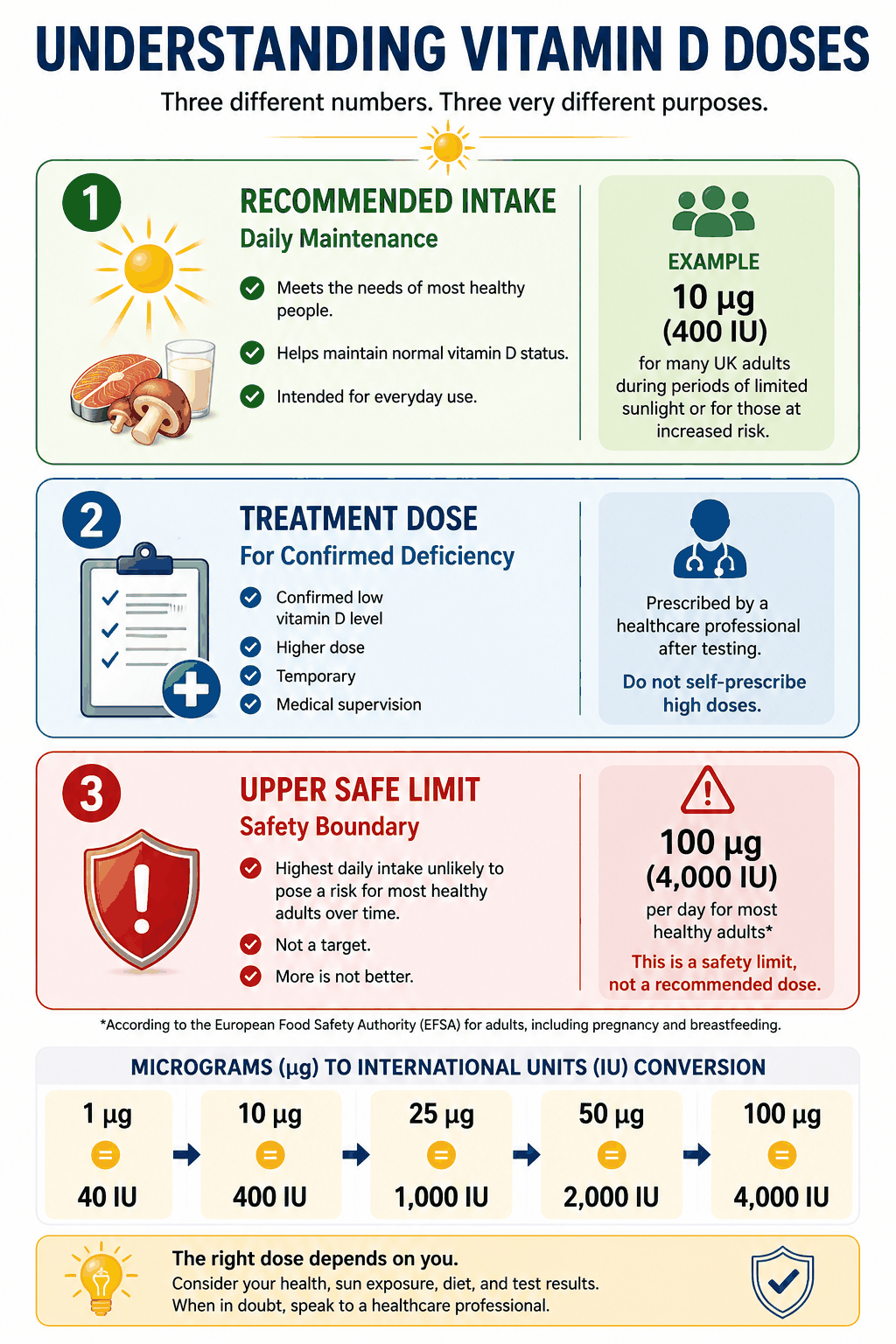
Understanding Three Different Numbers
Many people confuse three completely different concepts.
1. Recommended Intake
This is the amount intended to maintain normal vitamin D status in healthy people who require supplementation. For many adults in the United Kingdom, the NHS recommends 10 micrograms (400 IU) daily during periods when sunlight exposure is limited or for those at increased risk of deficiency. (nhs.uk)
2. Treatment Dose
A healthcare professional may prescribe a much higher dose for someone with a confirmed vitamin D deficiency.
These doses are:
temporary;
medically supervised;
often followed by a lower maintenance dose.
A treatment dose should never be copied simply because someone else received it.
3. Upper Safe Limit
The Upper Intake Level (UL) is the highest daily intake that is unlikely to pose a risk for most healthy adults over time. According to the European Food Safety Authority, this is:
100 micrograms (4,000 IU) per day
This is not a recommended daily target. It is a safety boundary. (efsa.europa.eu)
Micrograms and International Units
Vitamin D labels often use two different units. Fortunately, converting between them is simple.
Micrograms (µg) International Units (IU)
10 µg 400 IU
20 µg 800 IU
25 µg 1,000 IU
50 µg 2,000 IU
100 µg 4,000 IU
Understanding this conversion helps prevent accidental overdosing when comparing products.
More Is Not Always Better
It is easy to think:
“If vitamin D is good, taking twice as much must be even better.”
The human body rarely works that way. Vitamin D follows what many nutrients do:
Too little may lead to deficiency.
Too much may become harmful.
The goal is not to reach the highest number.
The goal is to reach the appropriate range.
Why Blood Tests Matter
Symptoms alone cannot reliably tell whether someone has low vitamin D. Fatigue, muscle aches, low mood, or weakness may have many possible causes. A blood test measuring 25-hydroxyvitamin D [25(OH)D] provides the best assessment of vitamin D status and helps guide treatment decisions when clinically indicated. Treating numbers without understanding the person can also be unhelpful. Good healthcare considers:
symptoms;
medical history;
medicines;
kidney function;
calcium levels;
and laboratory results together.
TAFAT Practical Advice
Before buying a vitamin D supplement, ask yourself:
✔ Do I know why I want to take it?
✔ Is this a maintenance dose or a treatment dose?
✔ Am I already getting vitamin D from another product?
✔ Have I checked the amount in both micrograms and IU?
✔ Would it be sensible to discuss this with my healthcare professional?
Sometimes the best decision is not a bigger dose. It is simply a better-informed one.
Truth Meter™
Statement Evidence
Everyone needs exactly the same dose.
🔴 False
Deficiency may require higher treatment doses.
🟢 Well Supported
4,000 IU is the ideal daily amount for everyone.
🔴 False
Blood tests can help assess vitamin D status.
🟢 Well Supported
The right dose depends on the individual.
🟢 Well Supported
TAFAT Research Highlight
🟢 Well Supported
Recommended intake, treatment doses, and upper safe intake levels are three different concepts. Confusing them is one of the most common causes of misunderstanding about vitamin D supplementation.
Vitamin D should not be taken according to what someone else needs. The right dose is the one that fits your individual circumstances, not the highest number printed on the bottle.
Sunlight, Food, and Supplements
Three Sources, Different Strengths
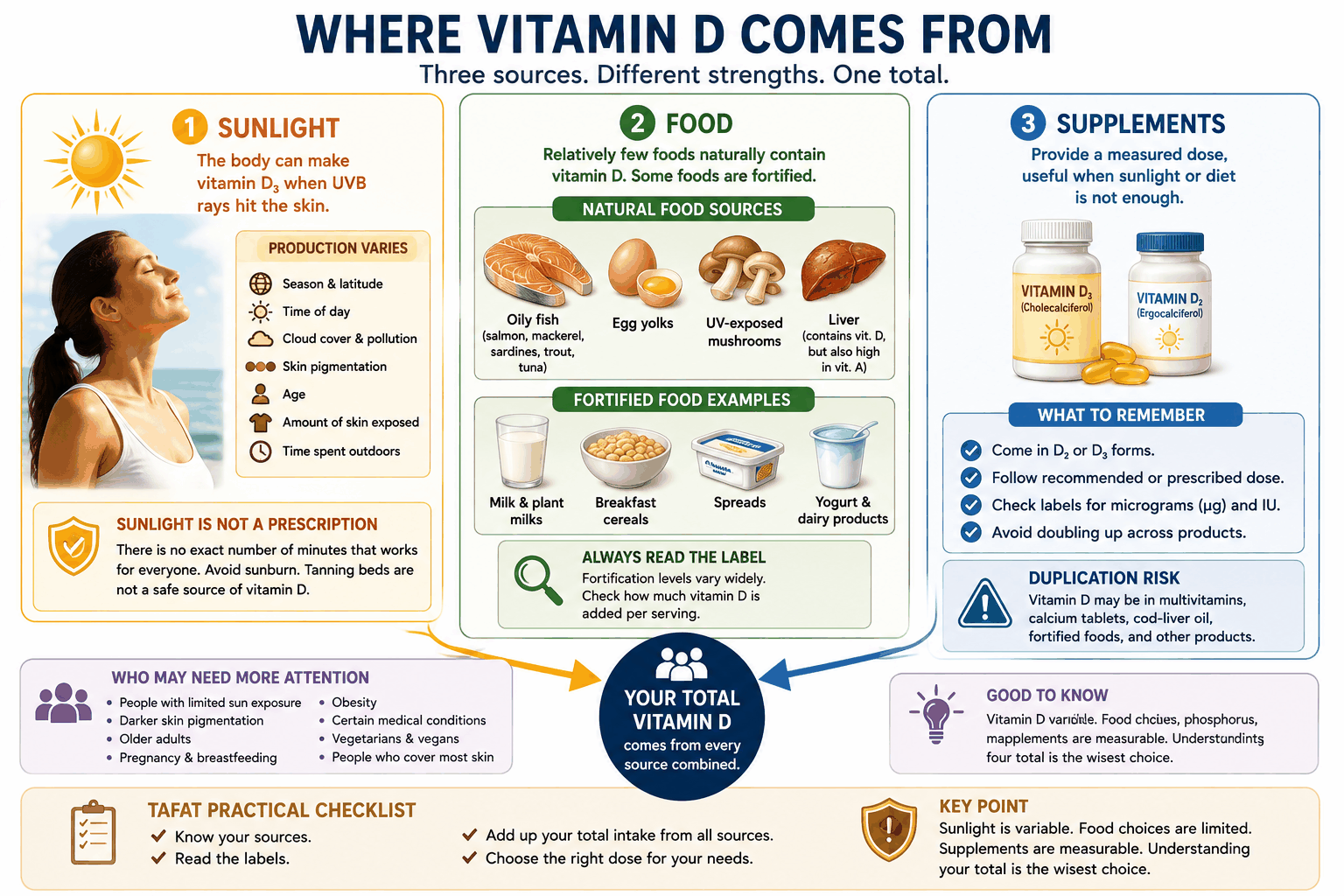
Vitamin D can reach the body through three main routes:
sunlight on the skin;
food;
supplements.
None of these sources is automatically best for every person. Sunlight varies with season and individual circumstances. Relatively few foods naturally contain substantial vitamin D. Supplements offer a measurable dose, but they also make accidental excess easier when products are combined. The most sensible approach is to understand what each source can and cannot provide.
Sunlight
When ultraviolet B radiation reaches uncovered skin, the body can begin producing vitamin D₃. This makes sunlight an important source, but not a precise one. The amount produced can vary greatly according to:
season and latitude;
time of day;
cloud cover and air pollution;
skin pigmentation;
age;
clothing;
amount of exposed skin;
and time spent outdoors.
In the United Kingdom, most people can produce more vitamin D from sunlight between late March or early April and the end of September. During autumn and winter, sunlight is generally insufficient for reliable skin production, which is why the NHS advises people to consider supplementation during those months.
Sunlight Is Not a Prescription
There is no single number of minutes in the sun that guarantees the same vitamin D production for everyone. Vitamin D is important, but sunburn is harmful. Tanning beds and prolonged unprotected exposure should not be used as vitamin D treatments.
The goal is sensible outdoor exposure, not deliberate skin damage.
Food
Only a limited number of foods naturally contain meaningful amounts of vitamin D.
The richest natural sources include:
salmon;
mackerel;
sardines;
trout;
tuna;
fish liver oils;
egg yolks;
liver;
and some ultraviolet-exposed mushrooms.
Fatty fish are among the strongest natural dietary sources. Some foods, including milk alternatives, breakfast cereals, spreads, and dairy products, may also be fortified with vitamin D, depending on the country and manufacturer.
Always Read the Label
Fortified does not mean every product in that category contains vitamin D. Two similar-looking cereals, milks, or spreads may provide very different amounts. The nutrition label should state whether vitamin D has been added and how much each serving contains.
Food Sources at a Glance
Source What to Know
Fatty fish -Among the richest natural sources
Egg yolks -Provides a smaller amount
Liver -Contains vitamin D, but also high vitamin A
UV-exposed mushrooms -Can provide vitamin D₂
Fortified foods -Amount varies considerably
Cod-liver oil -Contains vitamin D and vitamin A, so dosage needs care
A Note About Cod-Liver Oil
Cod-liver oil is not simply a vitamin D product. It may also contain substantial vitamin A. Taking it alongside a multivitamin or another vitamin A product can create unnecessary duplication, particularly during pregnancy. The full label matters more than the words “natural source.”
Supplements
Supplements provide vitamin D in a known amount, usually as:
vitamin D₂, or ergocalciferol;
vitamin D₃, or cholecalciferol.
They can be particularly useful when sunlight exposure is limited, dietary intake is low, or a healthcare professional recommends supplementation. The advantage of a supplement is precision. The disadvantage is that the dose can be repeated every day even when it is unnecessary, duplicated across several products, or misunderstood because of the difference between micrograms and international units.
One Source Does Not Cancel Another
Vitamin D from food, fortified products, multivitamins, separate supplements, and prescribed medicine all contributes to total intake.
A person may think:
“I only take one vitamin D capsule.”
Yet the same person may also receive vitamin D from:
a multivitamin;
calcium tablets;
a nutrition drink;
fortified milk;
and cod-liver oil.
The body does not separate these into different accounts. It sees the total.
Which Source Is Best?
The honest answer is that the best combination depends on the person.
Sunlight may contribute more when:
UVB exposure is sufficient;
the season and location allow skin production;
and exposure can occur without burning.
Food becomes especially valuable because:
it provides vitamin D together with protein, fats, and other nutrients;
it reduces dependence on pills;
and it supports the broader quality of the diet.
Supplements may be most useful when:
sunlight exposure is limited;
diet supplies little vitamin D;
a person belongs to a higher-risk group;
or deficiency has been identified.
TAFAT Truth Meter™
Statement Evidence
Sunlight can help the skin produce vitamin D
🟢 Well supported
Everyone produces the same amount from equal sun exposure
🔴 False
Many foods naturally contain large amounts
🔴 False
Fatty fish are among the richest natural sources
🟢 Well supported
Fortified foods always contain the same dose
🔴 False
Supplements can provide a reliable measured amount
🟢 Well supported
Natural sources can never contribute to excess
🟠 Needs context
TAFAT Research Highlight
🟢 Well Supported
Sunlight, foods, and supplements can all contribute to vitamin D status, but their reliability differs. Dietary reference values are commonly set on the assumption that sunlight exposure may be minimal or unreliable.
Sunlight is variable. Food choices are limited. Supplements are measurable. Wise vitamin D use begins by understanding the total contribution from all three.
Who Is More Likely to Become Deficient?
Not Everyone Begins in the Same Place
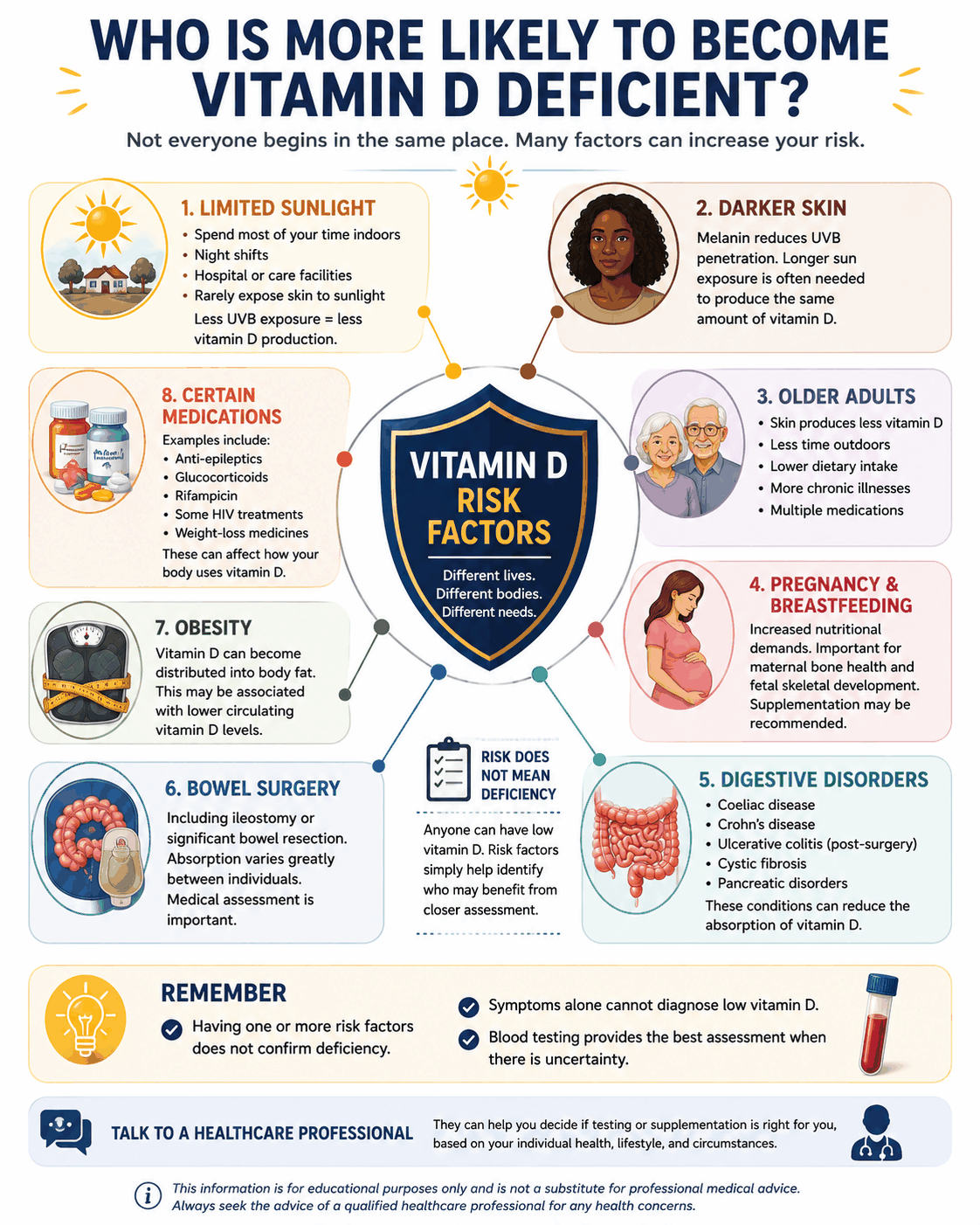
One of the biggest misconceptions about vitamin D is that everyone has the same risk of deficiency. They do not. A healthy young adult who spends time outdoors in summer may have very different vitamin D requirements from someone who is elderly, works indoors, has a digestive disorder, or lives in a region with little winter sunlight. This is why TAFAT does not recommend a single supplement strategy for everyone. Understanding your personal risk is often more important than buying the highest-dose product.
Limited Sun Exposure
The body depends on ultraviolet B (UVB) light to produce vitamin D.
People who spend most of their day:
indoors;
working night shifts;
in hospitals or care facilities;
or who rarely expose their skin to sunlight
may produce considerably less vitamin D than someone with regular outdoor exposure. This does not automatically mean deficiency is present, but it does increase the likelihood over time.
Darker Skin
Melanin helps protect the skin from ultraviolet radiation. Because melanin also reduces UVB penetration, people with darker skin generally require longer sunlight exposure to produce the same amount of vitamin D as someone with lighter skin. This becomes particularly important in countries further from the equator where winter sunlight is weaker. It is one reason some public health authorities identify darker-skinned populations as being at increased risk of vitamin D deficiency.
Older Adults
As we age, the skin becomes less efficient at producing vitamin D.
Older adults are also more likely to:
spend less time outdoors;
eat smaller amounts of vitamin D-rich foods;
have chronic illnesses;
take multiple medications.
Together these factors may increase the likelihood of low vitamin D status.
Pregnancy and Breastfeeding
Pregnancy increases nutritional demands. Vitamin D contributes to maternal bone health and supports normal fetal skeletal development. For this reason many countries provide guidance regarding vitamin D supplementation during pregnancy. However, pregnancy is not a reason to take high doses without medical advice. More is not automatically better.
Digestive Conditions
Vitamin D is absorbed through the digestive system. Conditions affecting absorption may reduce the amount reaching the bloodstream.
Examples include:
coeliac disease;
Crohn’s disease;
ulcerative colitis after certain surgeries;
cystic fibrosis;
pancreatic disorders;
bariatric surgery;
extensive bowel resection.
People living with an ileostomy or significant bowel surgery may also require individual medical assessment because absorption varies greatly between individuals.
Obesity
Vitamin D can become distributed into body fat. Some studies suggest that obesity is associated with lower circulating vitamin D concentrations, although the reasons are complex and involve more than simple storage alone. For this reason, some individuals with obesity may require personalized assessment rather than assuming a standard dose will be appropriate.
Medicines
Some medicines can affect vitamin D metabolism.
Examples include certain:
anti-epileptic medicines;
glucocorticoids;
rifampicin;
weight-loss medicines that reduce fat absorption;
some HIV treatments.
This is another reason why supplements should never be viewed in isolation from the rest of a person’s healthcare.
Risk Does Not Mean Deficiency
Belonging to one of these groups does not automatically mean a person is vitamin D deficient. Likewise, someone outside these groups may still have low vitamin D. Risk simply helps identify who may benefit from closer assessment. Where uncertainty exists, laboratory testing may provide a clearer answer than guessing.
TAFAT Risk Summary
You may benefit from discussing vitamin D with a healthcare professional if you:
✔ Spend very little time outdoors.
✔ Have darker skin and live in a region with limited winter sunlight.
✔ Are older.
✔ Are pregnant or breastfeeding.
✔ Have digestive or absorption disorders.
✔ Have undergone bowel surgery.
✔ Have obesity.
✔ Take medicines that affect vitamin D metabolism.
✔ Have previously been diagnosed with vitamin D deficiency.
Truth Meter™
Statement Evidence
Everyone has the same risk of deficiency.
🔴 False
Sunlight exposure influences vitamin D production.
🟢 Well Supported
Some medical conditions reduce vitamin D absorption.
🟢 Well Supported
Darker skin may require longer UVB exposure.
🟢 Well Supported
Risk factors automatically mean deficiency.
🔴 False
TAFAT Research Highlight
🟢 Well Supported
Vitamin D deficiency risk is influenced by lifestyle, geography, age, skin pigmentation, health conditions, digestive function, and certain medicines. Assessment should focus on the individual rather than assuming one recommendation fits everyone.
The question is not whether vitamin D is good. The better question is whether your body is likely to need more, less, or simply careful assessment.
Testing Vitamin D levels?
A Blood Test Is Better Than Guesswork
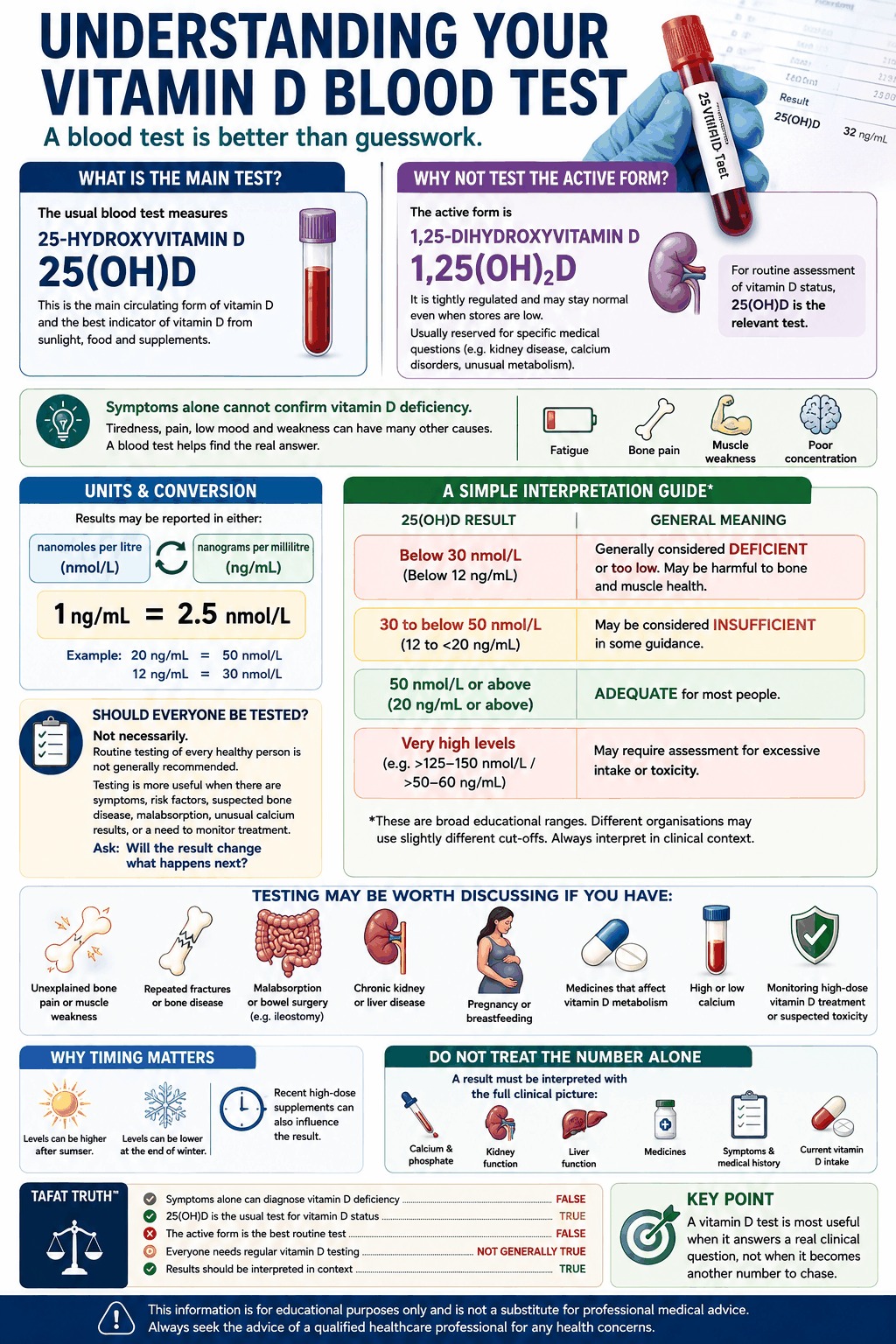
Vitamin D deficiency can be difficult to recognize from symptoms alone. Tiredness, muscle weakness, bone discomfort, poor concentration, or low mood may occur alongside low vitamin D, but these symptoms are not specific. They may also arise from anemia, thyroid disorders, infection, medication effects, sleep problems, chronic illness, or many other causes. For this reason, symptoms cannot confirm vitamin D deficiency by themselves. When testing is clinically appropriate, the usual blood test measures:
25-hydroxyvitamin D
Written as:
25(OH)D
This is the main circulating form of vitamin D and is widely regarded as the best available indicator of vitamin D obtained from sunlight, food, and supplements.
Why Not Test the Active Form?
The active form of vitamin D is called:
1,25-dihydroxyvitamin D
or:
1,25(OH)₂D
Although this form is biologically active, it is usually not the best routine test for vitamin D stores. The body regulates it tightly, and its level may remain normal or even rise while overall vitamin D stores are low. Testing the active form is generally reserved for particular medical questions involving kidney disease, calcium disorders, or unusual vitamin D metabolism. For ordinary assessment of vitamin D status, 25(OH)D is usually the relevant test.
Understanding the Result
Vitamin D blood results may be reported in either:
nanomoles per litre, written as nmol/L;
or nanograms per millilitre, written as ng/mL.
A useful conversion is:
1 ng/mL = 2.5 nmol/L
The NIH Office of Dietary Supplements describes levels below 30 nmol/L, or 12 ng/mL, as too low and potentially harmful to bone health. Levels of 50 nmol/L, or 20 ng/mL, and above are adequate for most people. EFSA similarly uses 50 nmol/L as a suitable reference target when setting dietary values for healthy populations.
Important caution
Laboratories and clinical organizations do not always use identical categories. A result should therefore be interpreted with the laboratory range, the person’s health, calcium level, kidney function, symptoms, and medical history in mind.
A Simple Interpretation Guide
25(OH)D result General meaning
Below 30 nmol/L Generally considered deficient or too low
30 to below 50 nmol/L May be considered insufficient in some guidance
50 nmol/L or above Adequate for most people
Very high levels
May require assessment for excessive intake or toxicity These are broad educational ranges, not a diagnosis. The meaning of a result may differ in people with:
kidney disease;
malabsorption;
bone disease;
pregnancy;
granulomatous disorders;
high blood calcium;
or prescribed high-dose treatment.
Should Everyone Be Tested?
Not necessarily. Routine vitamin D testing of every healthy person is not universally recommended. Testing is generally more useful when there are symptoms, risk factors, suspected bone disease, concerns about malabsorption, unusual calcium results, or a need to monitor treatment. Some NHS guidance advises against routine testing without a clinical reason. Testing without a clear purpose can also lead to unnecessary worry or treatment. The better question is:
Will the result change what happens next?
When Testing May Be Worth Discussing
A healthcare professional may consider testing when someone has:
symptoms suggestive of rickets or osteomalacia;
unexplained bone pain or muscle weakness;
repeated fractures or significant bone disease;
malabsorption or major bowel surgery;
chronic kidney or liver disease;
high or low blood calcium;
treatment with high-dose vitamin D;
suspected vitamin D toxicity;
or medicines that strongly affect vitamin D metabolism.
Why Timing Matters
Vitamin D levels can vary with the season. Someone tested near the end of winter may have a lower result than the same person tested after summer. Recent high-dose supplementation can also influence the result. This does not make testing unreliable. It means the timing and context should be recorded and considered.
Do Not Treat the Number Alone
A laboratory result is one piece of a larger picture.
A careful interpretation may also consider:
calcium;
phosphate;
parathyroid hormone;
kidney function;
liver function;
medicines;
symptoms;
and current supplement intake.
Two people with the same vitamin D number may not require exactly the same plan.
TAFAT Truth Meter™
Statement Evidence
Symptoms alone can diagnose vitamin D deficiency
🔴 False
25(OH)D is the usual test for vitamin D status
🟢 Well supported
The active form is the best routine test
🔴 False
Everyone needs regular vitamin D testing
🟠 Not generally supported
Results should be interpreted in context
🟢 Well supported
A vitamin D test is most useful when it answers a real clinical question, not when it becomes another number to chase.
Vitamin D₂ and Vitamin D₃
Similar Names, Not Quite Identical
Vitamin D supplements usually contain one of two forms:
Vitamin D₂, called ergocalciferol
Vitamin D₃, called cholecalciferol
Both forms can increase vitamin D levels and both enter the same general activation pathway through the liver and kidneys. However, they differ in origin, stability, and how effectively they may maintain vitamin D concentrations over time.
Vitamin D₂
Vitamin D₂ is generally produced when certain fungi or yeasts are exposed to ultraviolet light.
It may be found in:
UV-exposed mushrooms;
fortified foods;
prescription products;
vegan vitamin D supplements.
Because it can be sourced without animal-derived ingredients, vitamin D₂ has traditionally been a common choice for people following vegan diets.
Vitamin D₃
Vitamin D₃ is the form produced naturally in human skin after UVB exposure. Traditional supplement sources include lanolin, a wax obtained from sheep’s wool. Vitamin D₃ may also be obtained from certain algae or lichen, allowing manufacturers to produce vegan D₃ supplements. The label should state the source clearly when dietary or religious suitability matters. NHS medicines guidance notes that D₃ is often preferred where possible because some evidence indicates it may be more effective in correcting deficiency.
Does D₃ Work Better?
At ordinary recommended doses, both D₂ and D₃ can raise vitamin D levels. However, comparative research generally suggests that D₃ may raise or maintain blood 25(OH)D more effectively, particularly when larger or less frequent doses are used. This does not make D₂ ineffective, nor does it mean everyone must replace a suitable D₂ product.
The practical conclusion is:
D₃ is often preferred when both forms are suitable, but D₂ remains a legitimate source of vitamin D.
What Happens After You Take Them?
Both forms travel to the liver and are converted into circulating metabolites:
D₂ becomes 25-hydroxyvitamin D₂
D₃ becomes 25-hydroxyvitamin D₃
Many laboratory blood tests measure both and report the combined result as total 25(OH)D. From there, the kidneys and other tissues can help convert them into biologically active vitamin D compounds.
Which One Should You Choose?
D₃ may be the practical choice when:
you want the form naturally produced in human skin;
maintaining blood levels effectively is important;
you are comfortable with the stated source;
or a healthcare professional specifically recommends it.
D₂ may be appropriate when:
it has been prescribed;
it is the suitable vegan product available to you;
you already respond adequately to it;
or there is another practical or medical reason for choosing it.
Vegan shoppers should look carefully
Do not assume that all vitamin D₃ is animal-derived. Likewise, do not assume that a bottle marked “plant based” automatically provides D₂. Lichen-derived and some algae-derived D₃ products are available, but the manufacturer should state the source transparently.
D₂ and D₃ at a Glance
Vitamin D₂
Scientific name: Ergocalciferol
Common source: Fungi or yeast
Vegan suitability: Commonly vegan
Can raise vitamin D levels: Yes
May maintain levels as strongly as D₃: Not always
Vitamin D₃
Scientific name: Cholecalciferol
Common source: Skin production, lanolin, algae or lichen
Vegan suitability: Depends on the source
Can raise vitamin D levels: Yes
Often preferred for maintaining levels: Yes
Marketing Claims to Question
Be cautious when a company says:
“D₃ is the only usable form.”
That is too absolute.
Also question:
“Plant based means automatically superior.”
The source matters for ethics, dietary choices, and suitability, but it does not by itself prove greater clinical effectiveness.
The better questions are:
What form is used?
What is its source?
What dose does it provide?
Has the label stated the amount clearly?
Is it appropriate for the person taking it?
TAFAT Truth Meter™
Statement Evidence
Both D₂ and D₃ can raise vitamin D levels
🟢 Well supported
D₂ is useless
🔴 False
D₃ may maintain levels more effectively
🟢 Generally supported
All D₃ comes from sheep’s wool
🔴 False
Every vegan vitamin D product contains D₂
🔴 False
The source should be clearly disclosed
🟢 Good transparency practice
The choice between D₂ and D₃ matters less than choosing a transparent product, an appropriate dose, and a form suited to your medical and dietary circumstances.
Can You Take Vitamin D Every Day?
Often Yes, But the Dose and Reason Matter
Vitamin D is commonly taken every day, especially during seasons of limited sunlight or by people at greater risk of deficiency. For many healthy adults who need routine supplementation, a modest daily dose is practical and appropriate. The NHS advises that 10 micrograms, or 400 IU, daily is enough for most people who require supplementation, while warning adults not to exceed 100 micrograms, or 4,000 IU, daily unless directed by a clinician. The important question is therefore not simply:
“Can I take vitamin D every day?”
A better question is:
“What dose am I taking each day, why am I taking it, and what other vitamin D sources am I already using?”
Daily Maintenance Is Different From Treatment
Daily vitamin D may be used for two very different purposes.
Routine maintenance
This is intended to help prevent deficiency or maintain adequate vitamin D status. It usually involves a relatively modest amount taken consistently.
Treatment of confirmed deficiency
A clinician may prescribe a larger daily or weekly loading dose for a limited period. NHS guidance notes that adults receiving a loading dose for severe deficiency commonly take it for approximately six to ten weeks, after which they may move to a lower maintenance dose. A temporary treatment dose should not quietly become a permanent routine. That is where confusion can become dangerous.
Daily Does Not Automatically Mean Dangerous
The word daily can sound alarming when readers learn that vitamin D is stored in the body. But storage alone does not make an appropriate daily dose harmful. The body is designed to store and regulate vitamin D. The risk depends on:
how much is taken;
how long it is taken;
whether other products contain vitamin D;
whether the person has conditions affecting calcium or vitamin D metabolism;
and whether a high-dose treatment plan is being monitored.
A small maintenance dose and an unsupervised high dose are not equivalent simply because both are taken daily.
Daily Does Not Automatically Mean Necessary
The opposite assumption is also unsafe. A product being widely available does not mean every person needs it throughout the entire year. Daily supplementation may be more relevant when someone:
has limited sunlight exposure;
lives through seasons with weak UVB sunlight;
has darker skin in a low-sunlight region;
is housebound or older;
has low dietary intake;
has a condition affecting absorption;
or has been advised to take it by a healthcare professional.
Some people may already receive enough from sunlight, food, fortified products, or an existing supplement. The total matters more than the number of bottles.
What About Weekly or Monthly Doses?
Vitamin D may also be prescribed or supplied in less frequent schedules, including weekly or monthly dosing. Because vitamin D and its metabolites remain in the body for extended periods, a larger intermittent dose can sometimes provide the same average intake as smaller daily doses.
For example:
400 IU each day equals 2,800 IU each week in total.
1,000 IU each day equals 7,000 IU each week in total.
This does not mean readers should convert their own schedules without guidance. Different dosing patterns may have different purposes, and very large intermittent doses are not necessarily better simply because they are taken less often.
A Simple Daily Safety Check
Before taking vitamin D each day, check five things.
1. The dose
Is the amount modest maintenance, or is it a high treatment dose?
2. The units
Is the label written in micrograms, IU, or both?
3. Other products
Does your multivitamin, calcium supplement, cod-liver oil, nutrition drink, or prescription already contain vitamin D?
4. Your health
Do you have kidney disease, kidney stones, high blood calcium, sarcoidosis, hyperparathyroidism, or another condition affecting vitamin D metabolism?
5. The review date
When should the supplement, blood level, or treatment plan be reviewed?
When Daily Supplementation Deserves Extra Caution
Professional guidance is especially important when someone:
has reduced kidney function;
has previously had high blood calcium;
takes a thiazide diuretic;
has sarcoidosis or another granulomatous disorder;
has primary hyperparathyroidism;
takes several vitamin D-containing products;
or is receiving high-dose treatment.
Vitamin D may interact with medicines or alter calcium balance in ways that make ordinary assumptions unreliable. NIH guidance notes that medicines including orlistat, corticosteroids, some statins, and thiazide diuretics can affect vitamin D status or calcium-related risk.
Do You Need Breaks From Vitamin D?
There is no universal rule that everyone must stop vitamin D after a fixed number of weeks. A person using a modest maintenance dose because of continuing low sunlight exposure may take it longer term. Someone prescribed a loading dose should usually stop or reduce it according to the treatment plan.
Rather than inventing an automatic break, ask:
Has the reason for taking it changed?
Has the season changed?
Has the dose been reviewed?
Are other sources now being used?
Was this intended as maintenance or treatment?
TAFAT Truth Meter™
Statement Evidence
Vitamin D can be taken daily
🟢 Generally true
Every person should take it daily all year
🔴 Not universally supported
An appropriate maintenance dose commonly causes toxicity
🔴 False
A prescribed loading dose should continue indefinitely
🔴 False
Total dose and duration matter
🟢 Well supported
Weekly dosing is automatically safer than daily dosing
🔴 False
The Honest Answer
For many people, daily vitamin D is entirely reasonable. But daily is not the most important word. The most important words are:
appropriate dose, clear reason, known total, and timely review.
A supplement should remain connected to the purpose for which it was started.
Vitamin D can be taken every day, but repetition turns every dose into part of a larger total. Know the reason, respect the amount, and review the plan when circumstances change.
Hidden Vitamin D Duplication
When One Supplement Quietly Becomes Five
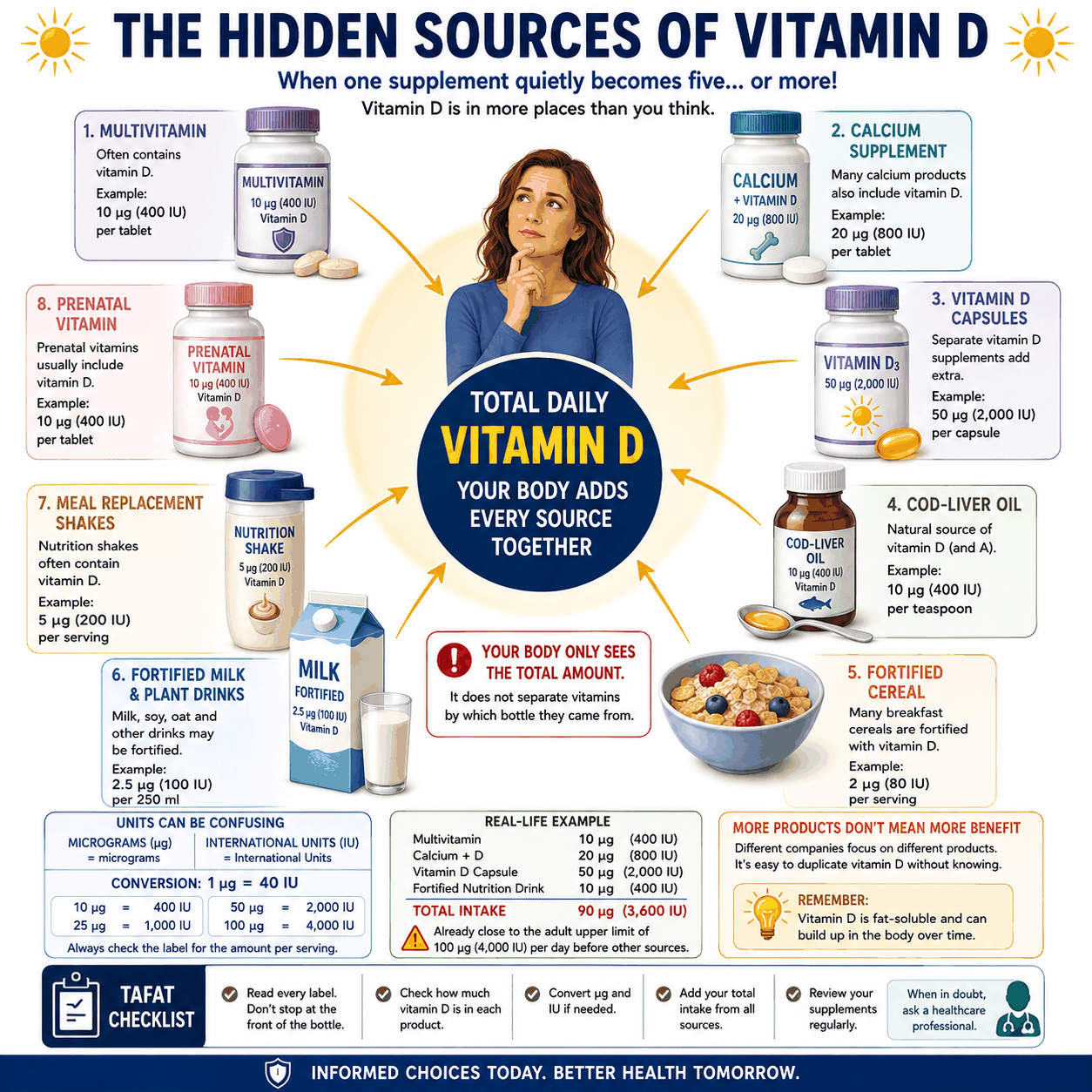
Most people who accidentally consume too much vitamin D are not trying to take excessive amounts. They are simply unaware that vitamin D is often included in several different products. A multivitamin may contain vitamin D. A calcium supplement may also contain vitamin D. A bone-health formula may add another dose. A nutrition drink may be fortified. A separate vitamin D capsule adds even more. Individually, each product may seem reasonable. Together, they can provide far more vitamin D than the person realizes.
The Hidden Sources
Vitamin D is commonly found in:
Multivitamins
Calcium supplements
Bone-health formulas
Cod-liver oil
Children’s vitamins
Prenatal vitamins
Sports nutrition products
Meal replacement shakes
Fortified breakfast cereals
Fortified milk and plant-based drinks
Prescription vitamin D
Separate vitamin D supplements
This is why reading only the front label is not enough. Always check the nutritional information panel.
The Labels Can Be Confusing
Some manufacturers list vitamin D in: Micrograms (µg)
Others use: International Units (IU) Some use both. Without recognizing the conversion, people may unknowingly compare products incorrectly.
Examples:
10 µg = 400 IU
25 µg = 1,000 IU
50 µg = 2,000 IU
100 µg = 4,000 IU
A Real-Life Example
Imagine someone takes:
A daily multivitamin containing 10 µg
A calcium tablet containing 20 µg
A vitamin D capsule containing 50 µg
Two servings of a fortified nutrition drink providing 10 µg
Each product looks perfectly reasonable.
Yet together they provide:
90 µg (3,600 IU) That is already approaching the adult tolerable upper intake level of 100 µg (4,000 IU) before considering any additional sources. The lesson is simple.
The body only sees the total amount.
It does not separate vitamins according to which bottle they came from.
More Products Do Not Mean More Benefit
Supplement companies often specialize in one category. A calcium manufacturer promotes calcium. A bone-health company promotes bone formulas. A multivitamin company promotes multivitamins. Each product may have a legitimate purpose. The problem arises when people combine them without checking for overlap. This is especially important because vitamin D is fat-soluble and repeated excessive intake may accumulate over time.
TAFAT’s Five-Minute Label Check
Before adding any new supplement, ask:
✔ Does this already contain vitamin D?
✔ How much vitamin D am I getting from my other supplements?
✔ Is the amount listed in µg or IU?
✔ Am I taking this because I need it or because I already own it?
✔ Has anyone reviewed my total intake recently?
Five minutes spent reading labels may prevent months of unnecessary supplementation.
TAFAT Truth Meter™
Statement Evidence
Vitamin D is often present in several products
🟢 Well supported
Reading only the front of the label is enough
🔴 False
The body responds to the combined intake
🟢 Well supported
More supplements always produce more benefit
🔴 False
Checking total intake is a sensible safety step
🟢 Well supported
TAFAT Research Highlight
One of the most preventable causes of excessive vitamin D intake is duplication across multiple products. The safest approach is to calculate your total daily vitamin D intake, not simply the amount listed on a single bottle.
Every bottle tells only part of the story. Your health is influenced by the total amount your body receives, not by the label on a single product.
What Happens When You Take Too Much Vitamin D?
Toxicity Is Rare, but It Is Real
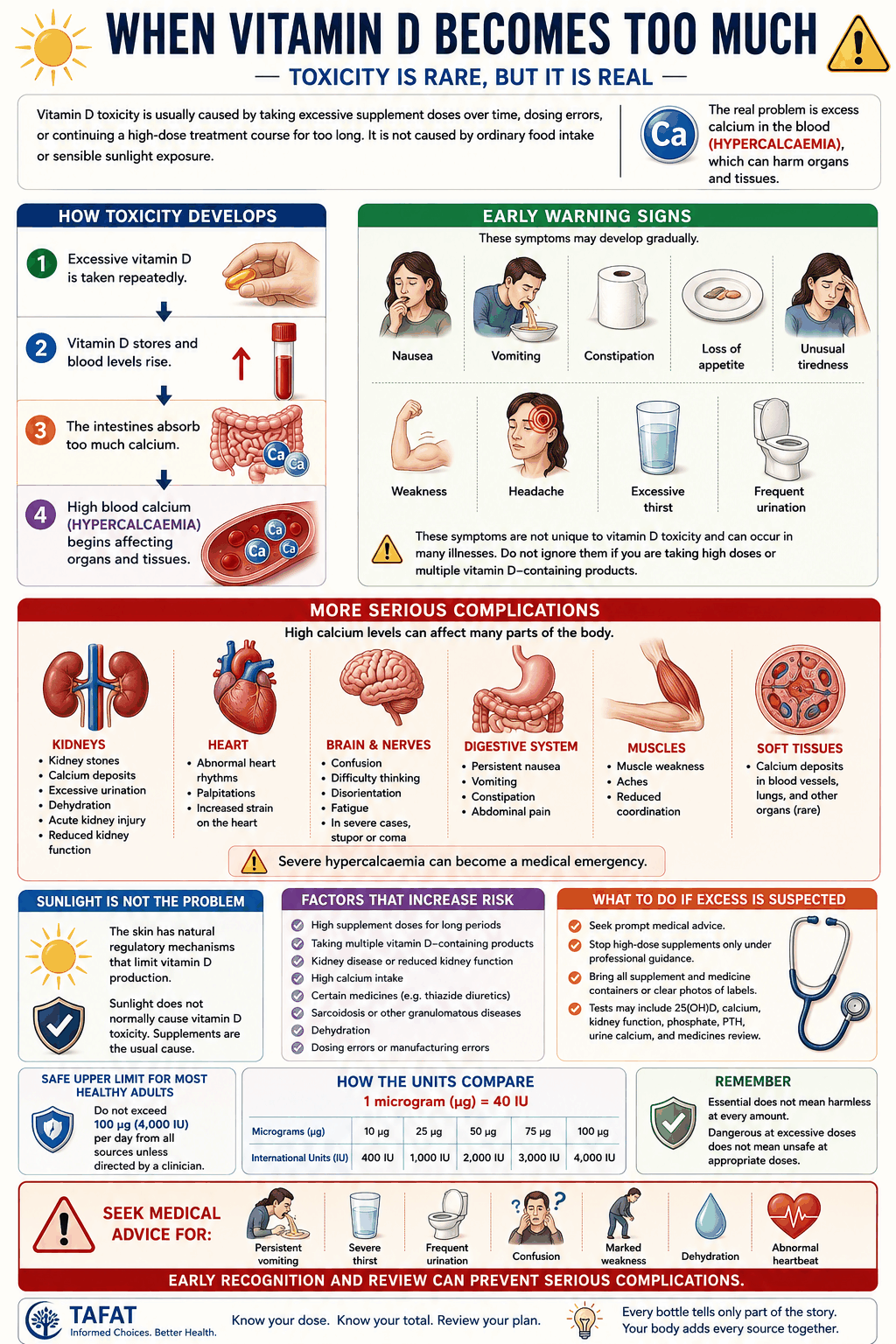
Vitamin D toxicity is uncommon. It is usually caused by taking excessive supplement doses over time, by dosing errors, or by continuing a high-dose treatment course longer than intended. It is not normally caused by ordinary food intake or sensible sunlight exposure. The central problem is not simply “too much vitamin D” sitting in the body. Excess vitamin D increases calcium absorption, which may raise calcium in the blood to harmful levels. This condition is called hypercalcaemia.
How Toxicity Develops
The process can be understood in four steps:
Excessive vitamin D is taken repeatedly.
Vitamin D stores and blood levels rise.
The intestines absorb too much calcium.
High blood calcium begins affecting organs and tissues.
The symptoms may develop gradually, which is one reason toxicity can be overlooked at first.
Early Warning Signs
Possible early symptoms of excessive vitamin D and hypercalcaemia include:
nausea;
vomiting;
constipation;
loss of appetite;
unusual tiredness;
weakness;
headache;
excessive thirst;
frequent urination.
These symptoms are not unique to vitamin D toxicity. They may occur in many illnesses, but they should not be ignored when someone has been taking high-dose vitamin D or several vitamin D-containing products.
More Serious Complications
As calcium levels rise, more serious problems may develop.
These can include:
dehydration;
confusion;
muscle weakness;
kidney stones;
calcium deposits in the kidneys;
acute kidney injury;
abnormal heart rhythms;
calcium deposits in other soft tissues.
Severe hypercalcaemia can become a medical emergency. Published clinical reports describe kidney injury and heart rhythm complications in serious cases.
Why the Kidneys Are Vulnerable
The kidneys help regulate calcium and activate vitamin D. When blood calcium becomes excessively high, the kidneys must filter a greater calcium load. This may contribute to:
excessive urination;
dehydration;
kidney stones;
calcium deposits within kidney tissue;
reduced kidney function.
This does not mean every person taking vitamin D will develop kidney damage. The concern is excessive or inappropriate intake, especially when combined with kidney disease, high calcium, dehydration, or other risk factors.
Does Toxicity Happen Suddenly?
Usually, vitamin D toxicity develops after repeated high intake rather than one ordinary dose. However, risk depends on more than a single number. It may be influenced by:
the dose;
duration;
dosing frequency;
age;
kidney function;
calcium intake;
medical conditions;
medicines;
and individual sensitivity.
This is why it is unwise to tell readers that toxicity always begins at one exact dose. The recognized adult upper limit of 4,000 IU, or 100 micrograms, daily is a long-term safety boundary for most healthy adults, not a guaranteed toxicity threshold.
Sunlight Does Not Usually Cause Toxicity
The skin has regulatory mechanisms that limit excessive vitamin D production from sunlight. This means vitamin D toxicity is generally associated with:
supplements;
prescription dosing errors;
manufacturing errors;
or unusually high intake from several combined products.
Sunlight can still damage the skin and increase skin-cancer risk, but it does not ordinarily cause vitamin D poisoning.
What to Do if Excess Is Suspected
Seek prompt medical advice when someone taking vitamin D develops:
persistent vomiting;
severe thirst;
unusually frequent urination;
confusion;
marked weakness;
dehydration;
kidney pain;
an irregular heartbeat;
or a sudden decline in wellbeing.
Bring all supplement and medicine containers, or clear photographs of their labels. The total intake may not be obvious until every source is added together.
A clinician may assess:
25(OH)D;
blood calcium;
kidney function;
phosphate;
parathyroid hormone;
urine calcium;
and current medicines or supplements.
Do not attempt to treat suspected toxicity by changing several medicines or supplements without appropriate clinical guidance.
A Necessary Balance
Learning about toxicity should not make readers afraid of all vitamin Deficiency can also cause real health issues. The purpose of this section is not to move from careless enthusiasm into unnecessary fear. It is to recognize that vitamin D is biologically active and deserves an informed dose.
Essential does not mean harmless at every amount. Dangerous at excessive doses does not mean unsafe at appropriate doses.
TAFAT Truth Meter™
Statement Evidence
Vitamin D toxicity is common at ordinary recommended doses
🔴 False
Excess vitamin D can raise blood calcium
🟢 Well supported
High calcium may damage the kidneys
🟢 Well supported
Food commonly causes vitamin D toxicity
🔴 False
Sunlight ordinarily causes vitamin D poisoning
🔴 False
High-dose supplements require care and review
🟢 Well supported
Vitamin D toxicity is rare, serious, and largely preventable. The safest protection is knowing your dose, knowing your total intake, and recognizing when a treatment plan requires review.
Who Should Be Especially Cautious?
When Vitamin D Deserves Extra Care
Vitamin D is an essential nutrient, but not every person responds to it in exactly the same way. For many healthy adults, modest maintenance supplementation is straightforward. For others, vitamin D should be taken with greater care because certain medical conditions can increase the likelihood of complications or change how the body processes vitamin D and calcium. This section is not intended to create fear. It is intended to help readers recognize when professional guidance is especially valuable.
Chronic Kidney Disease
Healthy kidneys perform two important jobs related to vitamin D.
They help:
convert vitamin D into its active hormonal form;
regulate calcium and phosphorus balance.
When kidney function is reduced, vitamin D metabolism may also change. Some people with chronic kidney disease require specialist forms of vitamin D rather than ordinary over-the-counter supplements. For this reason, kidney disease should never be treated with self-prescribed high-dose vitamin D.
Kidney Stones
Vitamin D itself does not directly create kidney stones. However, because vitamin D increases calcium absorption, excessive intake may contribute to higher urinary calcium in susceptible individuals.
People with:
recurrent kidney stones;
high urinary calcium;
or previous calcium stone disease
should discuss supplementation with their healthcare professional.
High Blood Calcium
If blood calcium is already elevated, adding vitamin D without understanding the cause may worsen the problem. High calcium levels require medical assessment before additional supplementation.
Hyperparathyroidism
The parathyroid glands help regulate calcium by producing parathyroid hormone (PTH). When these glands become overactive, calcium regulation changes. Vitamin D decisions should therefore be guided together with:
calcium;
PTH;
kidney function;
and overall clinical assessment.
Sarcoidosis and Other Granulomatous Diseases
Certain inflammatory diseases, including sarcoidosis, may activate vitamin D outside the kidneys. This unusual process can increase calcium levels even without large supplement doses. People living with these conditions should avoid assuming that ordinary over-the-counter supplementation is always appropriate.
Liver Disease
The liver performs the first major conversion of vitamin D. Significant liver disease may alter this process and influence vitamin D status. Assessment often requires considering the underlying liver condition rather than simply increasing supplement intake.
Digestive Disorders
Conditions that reduce fat absorption may also reduce vitamin D absorption because vitamin D is fat-soluble.
Examples include:
coeliac disease;
Crohn’s disease;
pancreatic disorders;
cystic fibrosis;
significant bowel surgery;
bariatric surgery.
The challenge may not be taking enough vitamin D. It may be absorbing enough.
Cancer Treatment
Some people receiving cancer treatment may also receive calcium or vitamin D as part of their medical care. Others may develop changes in calcium metabolism because of the disease itself. This does not mean vitamin D is unsafe during cancer treatment. It means supplementation should be coordinated with the treating medical team rather than added independently.
Medicines That Can Affect Vitamin D
Certain medicines may influence vitamin D absorption or metabolism.
Examples include:
corticosteroids;
some anti-epileptic medicines;
rifampicin;
orlistat;
cholestyramine;
certain HIV medicines;
thiazide diuretics.
This list is not exhaustive. Readers should always review medicines together with supplements.
Pregnancy
Vitamin D is important during pregnancy. However, pregnancy is not a reason to take unusually high doses unless specifically prescribed. More is not automatically better for either mother or baby.
Before You Start Vitamin D
Consider discussing supplementation if you have:
✔ Kidney disease
✔ Kidney stones
✔ High blood calcium
✔ Hyperparathyroidism
✔ Sarcoidosis
✔ Significant liver disease
✔ Malabsorption disorders
✔ Major bowel surgery
✔ Cancer treatment
✔ Multiple medicines
✔ Previous vitamin D toxicity
TAFAT Truth Meter™
Statement Evidence
Everyone can safely self-prescribe high-dose vitamin D
🔴 False
Some medical conditions change vitamin D metabolism
🟢 Well Supported
Kidney disease may require specialist management
🟢 Well Supported
Medicines can influence vitamin D
🟢 Well Supported
Professional advice is sometimes especially important
🟢 Well Supported
TAFAT Research Highlight
One of the most overlooked questions before starting a supplement is:
“Does my existing medical condition change how my body handles this nutrient?”
For vitamin D, the answer is sometimes yes. That is why good supplementation is not simply about choosing a quality product. It is about choosing the right product, at the right dose, for the right person.
Vitamin D is safest when it is matched to the individual. Medical history, medicines, kidney function, calcium balance, and digestive health all influence what may be appropriate.
Before You Buy Vitamin D
Evidence, Labels, Safety, and the Honest Verdict
Vitamin D products often promise support for bones, immunity, mood, energy, muscles, and general wellbeing. Some of those statements reflect genuine biological roles. Others stretch early or mixed research into claims that sound more certain than the evidence allows. The safest purchasing decision begins by separating three questions:
What does vitamin D actually do?
Do I have a reason to take more?
Does this product provide an appropriate dose without unnecessary duplication?
What Does the Evidence Support?
Strongly supported
Vitamin D is essential for:
calcium and phosphorus absorption;
normal bone mineralisation;
preventing rickets caused by deficiency;
preventing osteomalacia caused by deficiency;
supporting normal muscle and immune function.
Correcting a genuine deficiency is different from giving additional vitamin D to someone whose level is already adequate.
Still uncertain or dependent on circumstances
Research continues into vitamin D and:
mood;
fatigue;
respiratory infections;
cardiovascular disease;
diabetes;
autoimmune disease;
cognition;
cancer prevention.
Vitamin D may be biologically involved in these areas, but involvement does not prove that supplements prevent or treat the condition. A product should not turn an uncertain relationship into a guaranteed result.
How to Read the Label
Before looking at the marketing on the front, inspect the supplement information.
Check the form
The label may contain:
Vitamin D₂, or ergocalciferol;
Vitamin D₃, or cholecalciferol.
D₃ is commonly preferred, although both forms can raise vitamin D levels.
Check the dose
Vitamin D may be shown in:
micrograms, written µg;
international units, written IU.
1 µg = 40 IU
Therefore:
10 µg = 400 IU
25 µg = 1,000 IU
50 µg = 2,000 IU
100 µg = 4,000 IU
Check the serving size
A bottle may advertise a dose per capsule, drop, spray, or full serving. Read carefully before assuming one serving equals one tablet or one drop.
Check every other product
Add vitamin D from:
multivitamins;
calcium formulas;
prenatal supplements;
cod-liver oil;
nutrition drinks;
fortified products;
and prescribed medicines.
The NHS and EFSA advise most adults not to exceed 100 µg, or 4,000 IU, daily unless a clinician directs otherwise. This is an upper safety boundary, not an ideal daily target.
Marketing Claims to Question
Approach the product carefully when the label or sales page suggests that it:
cures disease;
prevents every infection;
guarantees more energy;
treats depression;
prevents cancer;
replaces sunlight, diet, or medical care;
is safer simply because it is “natural”;
or should be taken in the highest available dose.
A responsible product explains what it contains. It should not promise what evidence cannot guarantee.
The TAFAT Buying Checklist
Before buying, ask:
Why am I taking vitamin D?
Do I belong to a group at higher risk of deficiency?
Has deficiency been confirmed, or am I using a routine maintenance dose?
What form does the product contain?
What is the dose in both µg and IU?
How many servings will I actually take?
Is vitamin D already present in my other products?
Do I have kidney disease, kidney stones, high calcium, malabsorption, or another condition requiring care?
Does the seller distinguish evidence from advertising?
When should I review whether I still need it?
Frequently Asked Questions
Can I take vitamin D every day?
For many people, a modest maintenance dose can be taken daily. The reason, total dose, medical circumstances, and duration still matter.
Is vitamin D₃ better than vitamin D₂?
Both can raise vitamin D levels. D₃ is often preferred because it may maintain blood levels more effectively, but D₂ remains a legitimate option.
Should I take the highest dose available?
No. A higher number does not automatically provide greater benefit.
Can vitamin D damage the kidneys?
Appropriate doses do not commonly damage healthy kidneys. Excessive intake can cause high blood calcium, which may injure the kidneys.
Appropriate doses do not commonly damage healthy kidneys. Excessive intake can cause high blood calcium, which may injure the kidneys.
Can I get enough from sunlight?
Possibly, depending on season, location, skin pigmentation, lifestyle, age, and sun exposure. Sunlight is not a predictable dose.
Should everyone have a blood test?
Not necessarily. Testing is most useful when there is a clinical reason and the result may change management.
Is natural vitamin D always safer?
No. The source does not remove the importance of dosage, interactions, or total intake.
No. The source does not remove the importance of dosage, interactions, or total intake.
The Honest Verdict
Vitamin D is necessary. It is not a miracle cure, and it is not something to fear when used appropriately. The mistake lies at either extreme:
ignoring a genuine deficiency;
or assuming that more must always be better.
The strongest decision is neither blind enthusiasm nor unnecessary fear.
It is understanding.
Know why you take it. Know how much you take. Know every source contributing to the total.
Vitamin D should improve quality of life, not become another product taken merely because others are taking it. That is the heart of informed supplementation.
TAFAT Final Standard
A vitamin D product may be worth considering when it offers:
a clearly identified form;
an appropriate and understandable dose;
transparent labeling;
no hidden proprietary blend;
clear serving instructions;
reasonable value;
and claims that remain within the evidence.
No product is automatically the universally best choice. The right choice depends on the person, the purpose, the dose, and the information available at the time.
Quality of life comes before trends. Informed decisions help prevent avoidable outcomes.